
Solana: A Scalable Blockchain for Mass Adoption
The Future of Finance


Overview
Solana (SOL) is a high-performance open-source blockchain. Solana optimizes for low latency and low transaction costs enabled by its innovative consensus mechanism, Proof of History (PoH) combined with Proof of Stake (PoS), creating a scalable architecture. PoH separates time and state, which allows for efficient parallel processing of transactions, enhancing its performance. Its mainnet was launched on March 16, 2020, by the Solana Foundation, headquartered in Geneva, Switzerland. SOL’s original thesis was “blockchain at NASDAQ speed”. Since launch, several upgrades have improved network performance and resilience, including stake-weighted Quality of Service (QoS), local fee markets, and token extensions.
The Solana white paper was authored by Anatoly Yakovenko. Anatoly and the core Solana team have extensive backgrounds in building and developing cell phone networks at Qualcomm. Their backgrounds give them deep knowledge of building scalable and efficient networks.
Thesis: Key Features and Strengths
High-Performance Blockchain for the Masses:
Solana is architected for mass adoption, offering key features that address scalability limitations prevalent in other blockchains:
Ultra-Fast Transactions: Block times of 400 milliseconds with potential for further acceleration as hardware evolves.
Scalability for Growth: Designed to handle thousands of transactions per second (TPS) at low costs (under $0.0025 per transaction).
Decentralized Security: Secured by a geographically distributed network of over 1,761 validators, ensuring data integrity and censorship resistance.
Eco-Friendly Design: Solana's energy consumption per transaction is minimal, making it a sustainable choice. Each Solana transaction uses a similar amount of energy as a few Google searches.
Seamless User Experience: Clean and intuitive interfaces prioritize user experience, attracting both developers and consumers.
Strong Developer Base: Second only to Ethereum, with over 2,500 active developers building innovative applications. Solana has built a strong missionary developer culture after rising from the ashes of the post-FTX collapse.
Solana is Battle Tested: Solana’s technology and community have proven they can successfully endure arduous challenges and come out stronger. Solana has gained more mind share since Q4’23, due in part to the significant price appreciation through Q1’24.
Consumer-Centric Focus: Significant traction in mobile, NFTs, and gaming sectors. Solana launched its own mobile phone.
DePin blockchain: Solana’s high-throughput architecture has uniquely positioned it to support DePIN (decentralized infrastructure networks) projects like Render, Helium, Hivemapper, Teleport, and GenesysGo. These projects could only be built on Solana.
Cutting-Edge Innovation: Firedancer, a new validator client built from scratch in C++ by Jump Crypto, is live on testnet. Firedancer is expected to significantly improve the performance of Solana. In testing, Firedancer has processed one million TPS (compared to Solana Lab’s 55k TPS in comparable test environments).
Strong Investor Support: Solana has garnered the mind share of Jump Crypto and Multicoin Capital, which continue to invest capital and time to build and develop infrastructure and support ecosystem startups, which precipitate the positive flywheel adoption cycle.
Industries Disrupted
Solana's focus on scalability and high transaction throughput positions it well to disrupt several industries:
1. Decentralized Finance (DeFi):
Solana's Advantage: By enabling faster and cheaper transactions, Solana can make DeFi applications more accessible and scalable. This could lead to:
Increased adoption of DeFi services by a broader user base.
The emergence of more complex financial products and services on DeFi platforms.
2. Traditional Finance (TradFi):
Solana's Potential: Solana's capabilities could streamline TradFi processes by:
Enabling faster and more efficient settlements for trades and other financial transactions.
Reducing reliance on intermediaries, potentially lowering costs, and increasing transparency.
Creating opportunities for new financial instruments and services built on the blockchain.
3. Decentralized Infrastructure Networks (DePIN):
Solana's Advantage: High-throughput architecture has uniquely positioned Solana to be the DePIN chain, with projects like Render, Helium, and Hivemapper choosing to build on Solana.
4. Consumer Applications: Mobile, NFTs, and Gaming:
Solana's Advantage: Solana's faster transaction speeds could enable:
Creation of more immersive and interactive blockchain games.
Widespread adoption of NFTs for ticketing, digital collectibles, and in-game assets.
Improved user experience with faster processing of NFT transactions.
5. Payments:
Solana's Potential: Solana could revolutionize payments by:
Enabling faster and cheaper international transactions.
Facilitating micropayments that are currently impractical with traditional systems.
Creating opportunities for new payment methods and applications.
Value Proposition and Technology
Solana's North Star: Speed and Scalability
Anatoly envisioned Solana as a decentralized network that rivals the performance of a single node. This vision, "Solana's north star," prioritizes speed and scalability to enable mass adoption and real-world applications. Solana positions itself as a high-performance blockchain platform designed for scalability and usability. Solana's unique technology stands out as a core strength that fuels its overall value proposition. The focus on both high performance for users and easy integration for developers within the Solana ecosystem creates a powerful combination that could significantly drive future adoption and network growth.
Technological Differentiation:
Solana's unique approach to consensus combines Proof-of-History (PoH) with Proof-of-Stake (PoS). This, coupled with innovations like Turbine and Gulfstream, significantly reduces validation times for transactions and smart contracts. Additionally, PoH acts as a verifiable clock, minimizing communication overhead and accelerating transaction processing. This hybrid approach positions Solana for superior scalability compared to legacy blockchain architectures.
Key Technological Innovations:
To achieve its north star, Solana boasts a suite of eight key innovations, detailed in Anatoly's "8 Innovations that Make Solana the First Web-Scale Blockchain" article. These innovations work together to optimize transaction processing and smart contract execution.
Proof of History (POH): Establishes a verifiable global clock, reducing communication overhead and accelerating transaction processing.
Tower BFT: Optimizes Byzantine Fault Tolerance (BFT) consensus for PoH, improving efficiency.
Turbine: Enables high-throughput block propagation for faster transaction dissemination.
Gulf Stream: Provides a memory management system for efficient data handling.
Sealevel: Facilitates parallel smart contract execution, boosting processing speed.
Pipelining: Optimizes transaction validation through a Transaction Processing Unit (TPU).
Cloudbreak: Enables a horizontally scaled account database for improved scalability.
Archivers: Distribute ledger storage for reliability and redundancy.
Solana's architecture presents a compelling value proposition. The focus on speed, scalability, and user experience paves the way for mass adoption and fosters a vibrant developer ecosystem. Continued development and real-world implementation will determine the ultimate success of Solana's technological vision.
Tokenomics
Solana’s native token is SOL, which has three main uses: transaction fees, staking, and governance. SOL can be used to pay transaction fees and interact with dApps and smart contracts on the Solana network. SOL holders can contribute to the network by staking their tokens as part of Solana’s Proof-of-Stake (PoS) consensus mechanism. By staking SOL, users are helping to secure the network and earn rewards for helping validate transactions. SOL token holders can participate in the governance of the Solana protocol by voting on proposals and decisions that impact the future of the network. Giving token holders a voice in building the Solana ecosystem.
Network Participants:
Validators: Secure the network, verify transactions, and earn rewards.
Nodes: Participate in the network, with different types serving different purposes.
Stakers: Contribute to security by delegating their SOL to validators and earn rewards.
Total Supply: Uncapped, with an estimated 700 million tokens by January 2030.
Current Supply: 575 million tokens (447 million circulating, 128 million non-circulating).
Validators participate in securing the network by staking SOL to receive rewards in newly issued SOL and a portion of transaction fees (50% of transaction fees are burned, and the other 50% is awarded to the validator processing the block). The standard fee is fixed at 0.0000005 SOL per signature, or ~8% of a penny in USD. Solana implemented local fee markets, which allow for transaction prioritization.
The initial token supply of SOL was 500MM tokens, and new issuance awards to validators have increased the total outstanding supply of SOL to 575MM (447MM circulating supply, or 78%, and 127MM non-circulating supply, or 22%). The total supply of SOL is projected to reach 700MM tokens by January 2030. Solana set the initial annualized inflation rate at 8% in February 2021, scheduled to reduce by 15% every 180 epochs (approximately every year) until it reaches its long-term inflation target of 1.5% (estimated to happen in 2031). See the chart below for the supply schedule.
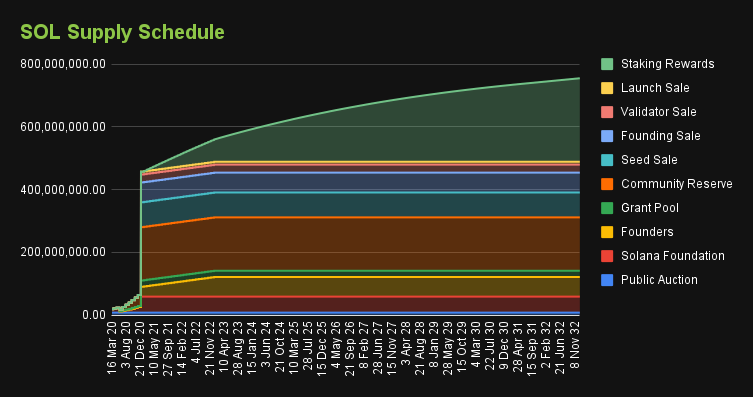
The initial SOL token allocation
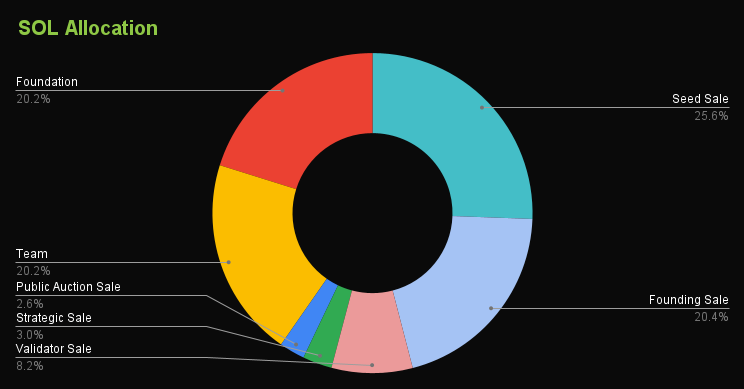
The SOL supply schedule and allocation are from coingecko.
15.86% is allocated to Seed sale
12.63% is allocated to Founding sale
5.07% is allocated to Validator sale
1.84% is allocated to Strategic sale
1.60% is allocated to Public Auction sale
12.50% is allocated to Team
12.50% is allocated to Foundation
38.00% is allocated to Community Reserve
Solana raised several early funding rounds from VCs before the initial token launch.
Seed Sale in March 2018 raised $3.17MM priced at $0.04
Founding Sale on June 3, 2018 raised $12.6MM priced at $0.2
Validator Sale on July 9, 2019 raised $5.7MM priced at $0.225
Strategic Sale on Feb. 18, 2020 raised $2.3MM priced at $0.25
Public Auction on March 24, 2020 raised $1.8MM priced at $0.22
There is ~22% of the SOL supply that is not in circulation yet. This comprises SOL that will be unlocked based on different vesting schedules connected with early investors as well as SOL owned by Solana Labs and the Solana Foundation (which are not subject to lockups but are not considered circulating). The largest holder of locked SOL is FTX/Alameda Research, which holds over 45MM SOL scheduled to be unlock from early 2023 until July 2025.
Staking: As of May 2024, 368MM SOL, or 64% of the total supply of SOL is staked. The current annualized staking yield is 7.39%. The staking yield changes depending on the performance of the network. The majority of the validator’s reward comes from new issuance, since there is such a low fee structure for SOL. As the inflation rate of SOL declines, validators will have to focus on transaction fees for a larger portion of total rewards, which will require a significant increase in network activity to develop a larger fee market.
Solana's tokenomics prioritize network security and staker incentives through staking rewards and a deflationary mechanism (50% of transaction fees are burned, reducing total supply over time). The long-term sustainability of staking yields will depend on increased network activity and transaction fees.
Ecosystem
Solana has started 2024 strong, with significant growth across its network and ecosystem fostered by the Solana Foundation, Solana Labs, and other third-party organizations like Helius, Colosseum, and SuperteamDAO. Active developers on Solana continue to grow and build. The Solana ecosystem has seen an expanding retail user base, DeFi and NFT investors, airdrops, and memecoin degens rush to use and explore Solana dApps. Solana’s ecosystem has developed hundreds of projects across sectors, including Consumer, DeFi, DePIN, Infrastructure, NFTs, Gaming, and payments. Solana continues to improve its use for both developers and users by expanding wallets, developer tools, and explorers.
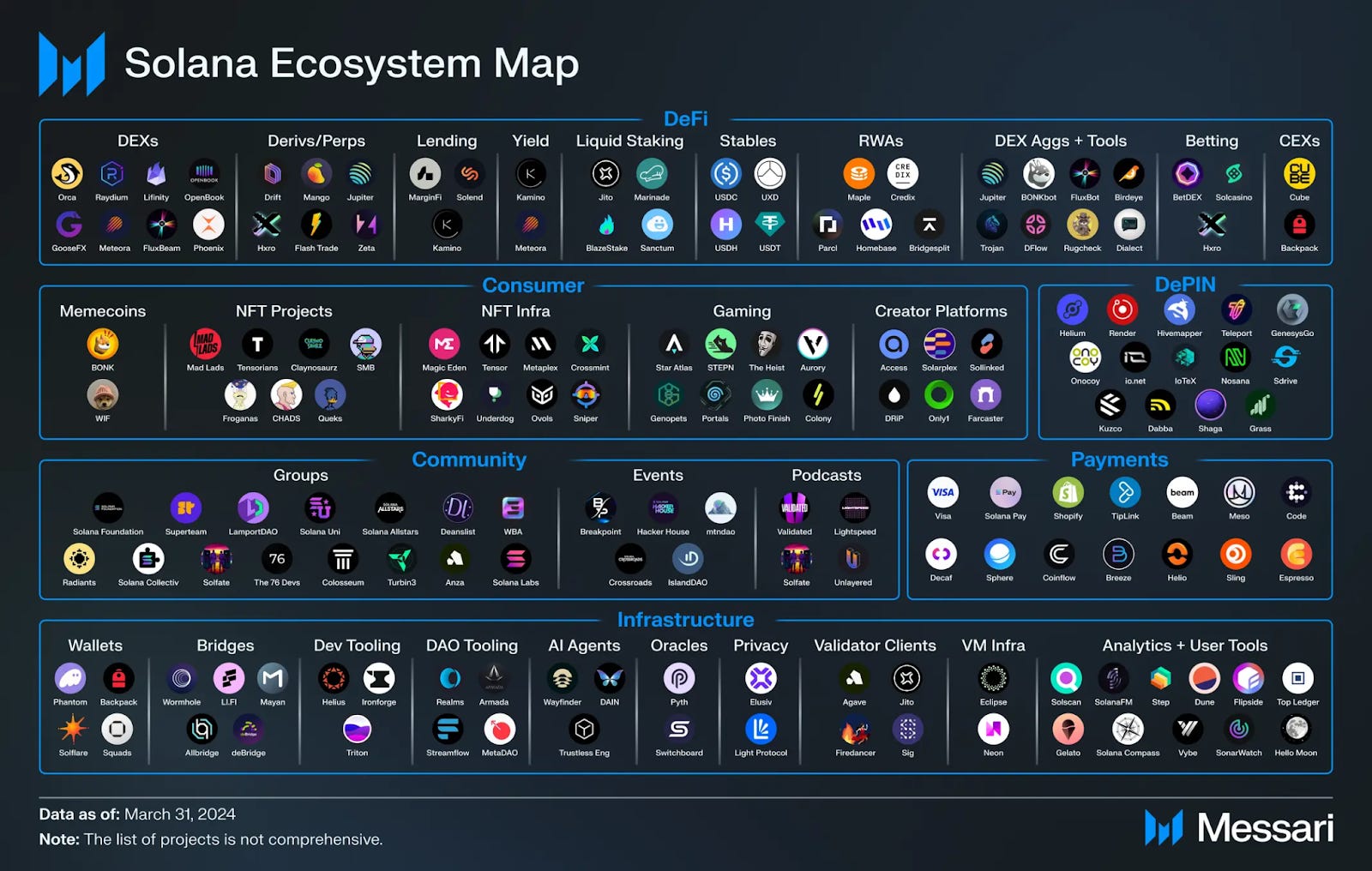
A recent Solana ecosystem map from Messari.
Developers: Solana’s developer ecosystem has grown to the second largest ecosystem in total monthly active developers. The Solana Foundation reports that between 2,500 and 3,000 monthly active developers were building on Solana in 2023.
DeFi: Solana’s TVL has climbed to $4.5Bn in Q1 '24, up from ~$280MM TVL for most of 2023. The current TVL is still below the ATH of $10Bn TVL reached on 11/8/21.
DEX Volume: Solana’s ~$1Bn+ daily DEX volume has increased significantly from ~$50MM for most of 2023. DEX volume started to pick up in Q4 '23 and climbed to $3.8Bn in March 2024. Memecoin trading helped drive a meaningful uptick in DEX volume.
Stablecoin: Solana overtook ETH in stablecoin volume in late December 2023 and has continued to lead in monthly stablecoin volume in 2024. In March 2024, Circle’s Cross-Chain Transfer Protocol (CCTP) launched on Solana. CCTP allows USDC to be easily transferred across networks without requiring wrapped USDC.
NFT volume: Average daily NFT volume continues to increase to $7.6MM for Q1’24. Tensor’s market share grows to 71%, and Magic Eden’s market share declines to 25%. The true OG Solana NFT project is The Degenerage Ape Academy. Its mint congested the young Solana network, giving birth to Solana’s NFT ecosystem and garnering more attention.
Airdrops: Solana continues to see airdrops across its ecosystem, which creates a wealth effect and empowers users to explore deeper into the Solana ecosystem. Notable airdrops include: Bonk, Jupiter, Pyth, Jito, Tensor, Parcl, Drift Protocol, and Zeus.
Potential airdrops: Phantom
Firedancer: Jump Crypto unveiled Firedancer in August 2022. This next-generation validator client, built entirely from scratch in C++, promises a major leap in transaction processing speed. If these performance gains translate to real-world TPS, Firedancer could significantly enhance Solana's scalability and competitiveness.
Solana Mobile Chapter 1: Solana Labs launched the Solana Saga, an iOS phone, in April 2023, and in early 2024, it quickly sold out when the value from airdrops became more than the price of the phone (originally $1,000 and dropped to $600 in 2H of 2023).
Solana Mobile Chapter 2: After the success of the Solana Saga, Chapter 2 was announced in Q1’24 at a lower price of $450, and pre-orders exceeded 100k within a month.
Telegram bots have exploded in popularity with retail users. About 5% of the total quarterly volume came from Telegram bots. BONKbot was the most popular, averaging $37MM daily volume.
So much is changing and developing on Solana. Below are a few great resources to stay up to speed on the Solana ecosystem:
Solana’s GitHub
Messari’s Solana Quarterly Reports (see Q1’2024)
Seb Montgomery provides a great daily Solana video update that provides timely updates on the Solana ecosystem.
Top Solana Podcast: Lightspeed, Validated, and Unlayered.
VanEck’s: Solana Valuation by 2030.
Solana Economic Model from @StrategicHash and @SolBeachBum
Team and Investors
Solana is led by a team of accomplished individuals with a shared vision for high-performance networks. Leading the team is Anatoly Yakovenko, the CEO and co-founder. Yakovenko boasts a versatile background, excelling in both software engineering (Qualcomm, Dropbox) and entrepreneurship (Alescere, Solana Labs).
The Solana team is a powerhouse of talent, including Raj Gokal (co-founder), Greg Fitzgerald, and Stephen Akridge. Their expertise spans mathematics, physics, computer science, and engineering. The diverse skill sets provide a comprehensive understanding of the challenges faced in building a scalable and robust Layer 1 protocol. Solana releases open-source libraries and tools to foster a developer-friendly environment and accelerate dApp creation on the Solana platform.
Competitive Landscape
The Layer 1 landscape is competitive, and it's unlikely a single blockchain will dominate all applications. All networks have various trade-offs that will impact product-market fit. Solana is growing its market share in the smart contract space with its focus on speed. Unlike traditional Proof-of-Work (PoW) networks like Bitcoin and even legacy Proof-of-Stake (PoS) systems like Ethereum, which struggle with scalability, Solana boasts significantly faster transaction processing speeds.
Solana's Advantage: A Scalable Foundation
Solana's unique architecture prioritizes native scalability at the base layer, setting it apart from platforms relying on Layer 2 solutions. This "monolithic" approach offers potential advantages in terms of simplicity and efficiency.
The Incumbent: Ethereum (ETH)
Ethereum is the dominant leader in the Layer 1 space, attracting significant investment and mind share. However, its scalability limitations hinder its ability to support large-scale adoption at the base layer. Ethereum addresses this with Layer 2 and Layer 3 solutions, but this introduces complexities and potential centralization concerns. Solana offers a compelling alternative: native scalability within the base layer.
Syncracy offers a glimpse into the future complexity of modular stacks compared to Solana's modular approach.
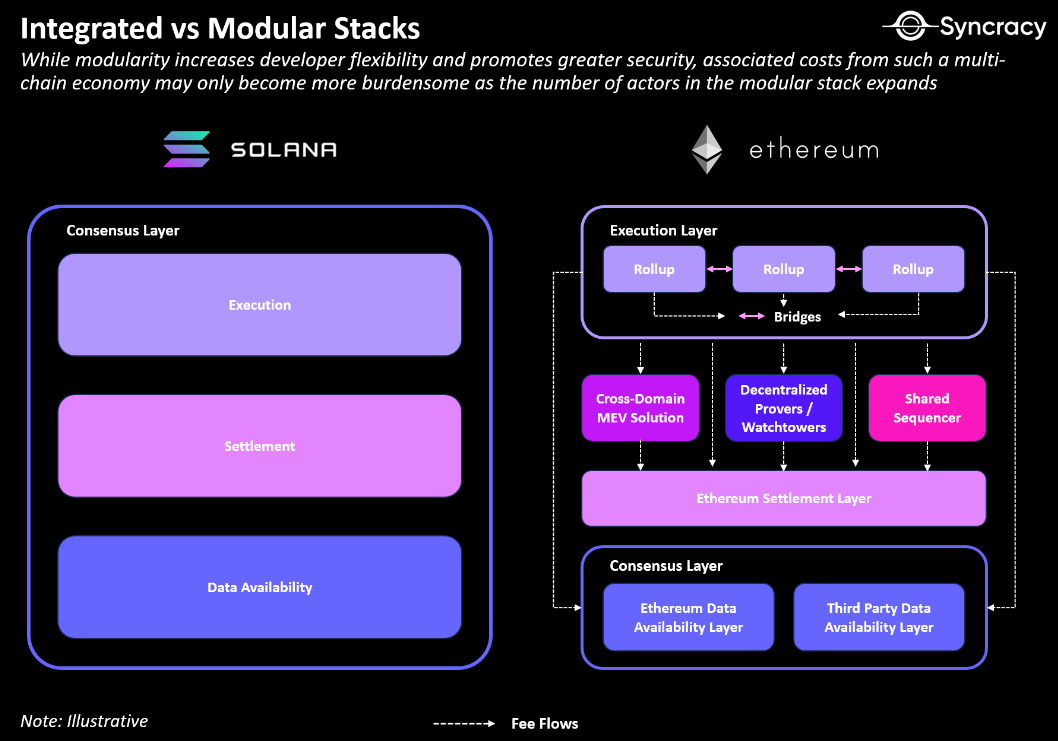
High-Performance Challengers: Avalanche and Polkadot
Solana faces competition from other high-performance Layer 1 platforms like Avalanche and Polkadot. While these platforms are gaining traction, they currently lag behind Ethereum and Solana in key metrics.
Emerging Threats: New Layer 1 Networks
New Layer 1 blockchains like SEI and Aptos are promising, but it takes time to build a robust developer and user base. Launching a successful Layer 1 network is becoming increasingly challenging as established ecosystems like Ethereum and Solana attract top developers. However, rapid technological advancements could dethrone an early incumbent.
Centralized Alternatives: BASE and Binance Smart Chain (BSC)
Centralized networks like BASE from Coinbase and BSC from Binance offer formidable competition. They boast low-latency transactions and large user bases, facilitating faster product rollouts. The tech stacks are different, with BSC having its own smart chain and Coinbase building BASE on the open-source OP stack from Optimism. However, their centralized nature deviates from Solana's focus on speed and decentralization.
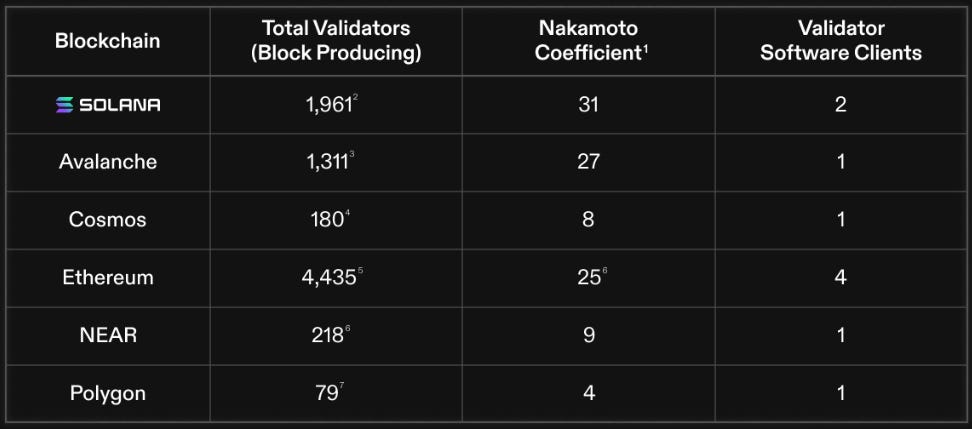
The below chart is from a 2023 validator report showing Solana as one of the largest PoS networks by node count and one of the most decentralized, as measured by Nakamoto Coefficient and validator software clients.
Solana's unique architecture and technological strengths position it as a strong contender in the smart contract race. Continued development and real-world implementation will determine its ultimate success in attracting developers and users.
Growth and Rank
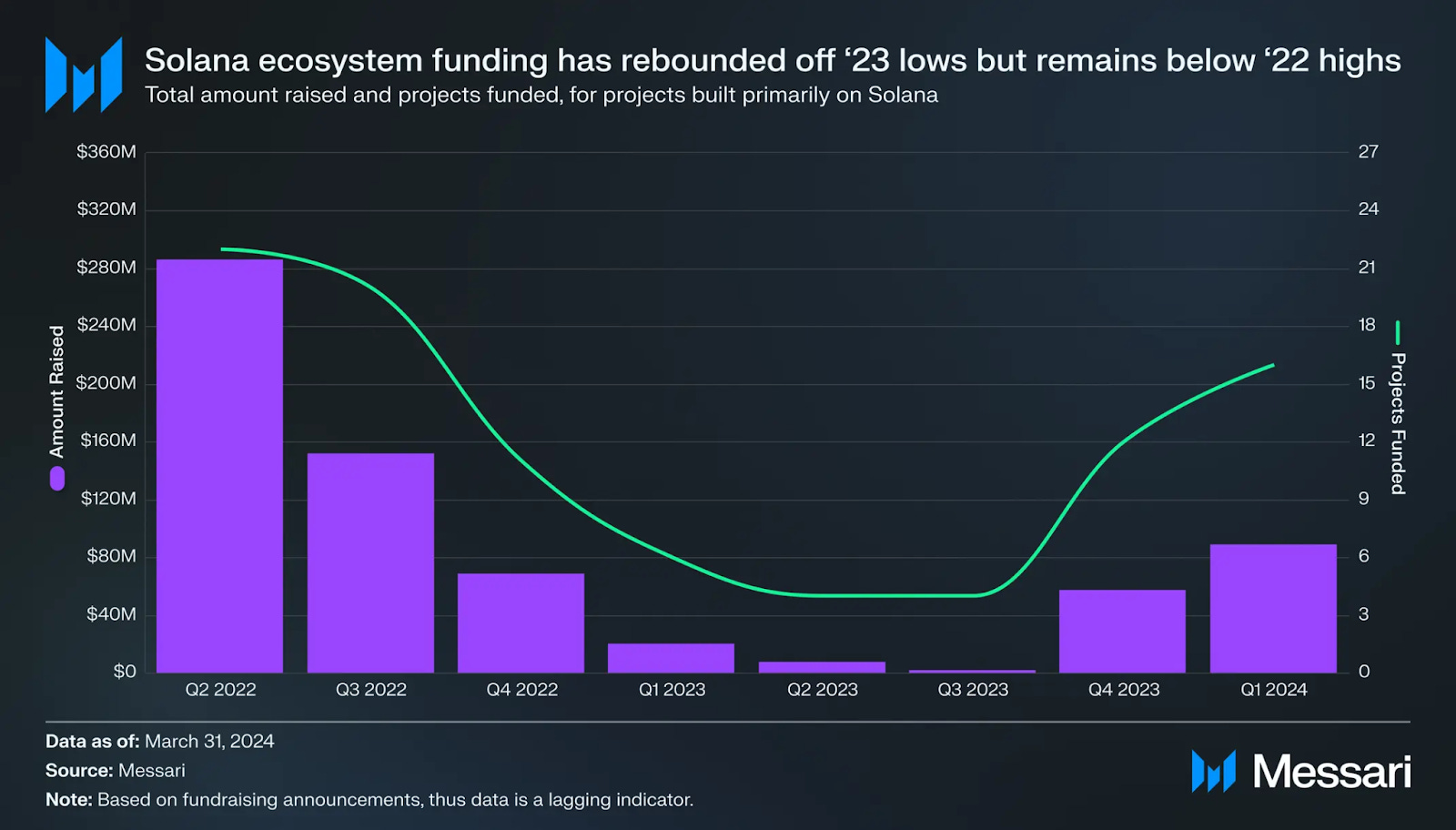
Solana continued to build during the bear market, and ecosystem funding is growing. As Messari notes in a recent report, 16 projects on Solana announced funding rounds in Q1’24 totaling $89MM raised, which was $2.5MM more than the total amount raised during all of 2023.
Solana continues to see success from its hackathons, which historically have garnered attention, and top projects have gone on to raise VC funding.
The Solana ecosystem has developed and is becoming more decentralized, and more community-organized projects and events are blossoming.
The Solana Labs Incubator in Q4’23 selected six teams to join in March 2024. The group will include Armada, a tokenomics tooling platform; Espresso Cash, a payments app; Juicer, a yield-optimizer; Sanctum, a liquid staking liquidity layer; Shaga, a DePIN network for gaming computers; and Zeebit, an onchain gaming platform.
Risks and Challenges
Outages and Congestion: Solana prioritizes rapid innovation, and network outages and congestion have occurred in the past. These issues are being addressed through ongoing network upgrades, but highlight the challenges of achieving high performance at scale.
Ethereum's Dominance: Ethereum remains the established leader, attracting significant investment and a larger user base. While Solana offers a compelling alternative, overcoming Ethereum's mindshare will be a significant challenge.
Security Risks: All blockchain platforms are susceptible to security vulnerabilities. Continuous security audits and a robust developer base are crucial for maintaining user trust.
Scalability: While Solana boasts high throughput, real-world usage could expose unforeseen limitations requiring further development and updates.
Technical Maturity: As a relatively new technology, Solana may face unforeseen technical challenges that need to be addressed.
Evolving Regulations: The regulatory landscape surrounding DeFi and digital assets is rapidly changing. Uncertainties in regulations could impact the adoption and functionality of Solana and other blockchain platforms.
Summary
Solana positions itself as a high-speed, scalable blockchain for mass adoption. Its innovative architecture prioritizes transaction throughput at the base layer, boasting faster speeds and lower fees compared to Ethereum. An active developer community and growing adoption of DeFi, NFTs, and dApps highlight Solana's potential. However, network outages and the dominance of Ethereum remain key hurdles. Overall, Solana's focus on scalability and user experience makes it a strong contender in the Layer 1 battle, but its long-term success hinges on overcoming technical hurdles and attracting a wider user base.
This document and the information contained herein have been provided solely for informational purposes. Nothing contained in this document constitutes investment, legal, or tax advice. You should conduct your own research and evaluations of the information herein.